
 EN
EN

News
SEPAT Evaporative Coolers Deployed at a Hong Kong MTR Station to Keep Commuters Cool in Record Heat
Time : 2026-09-18
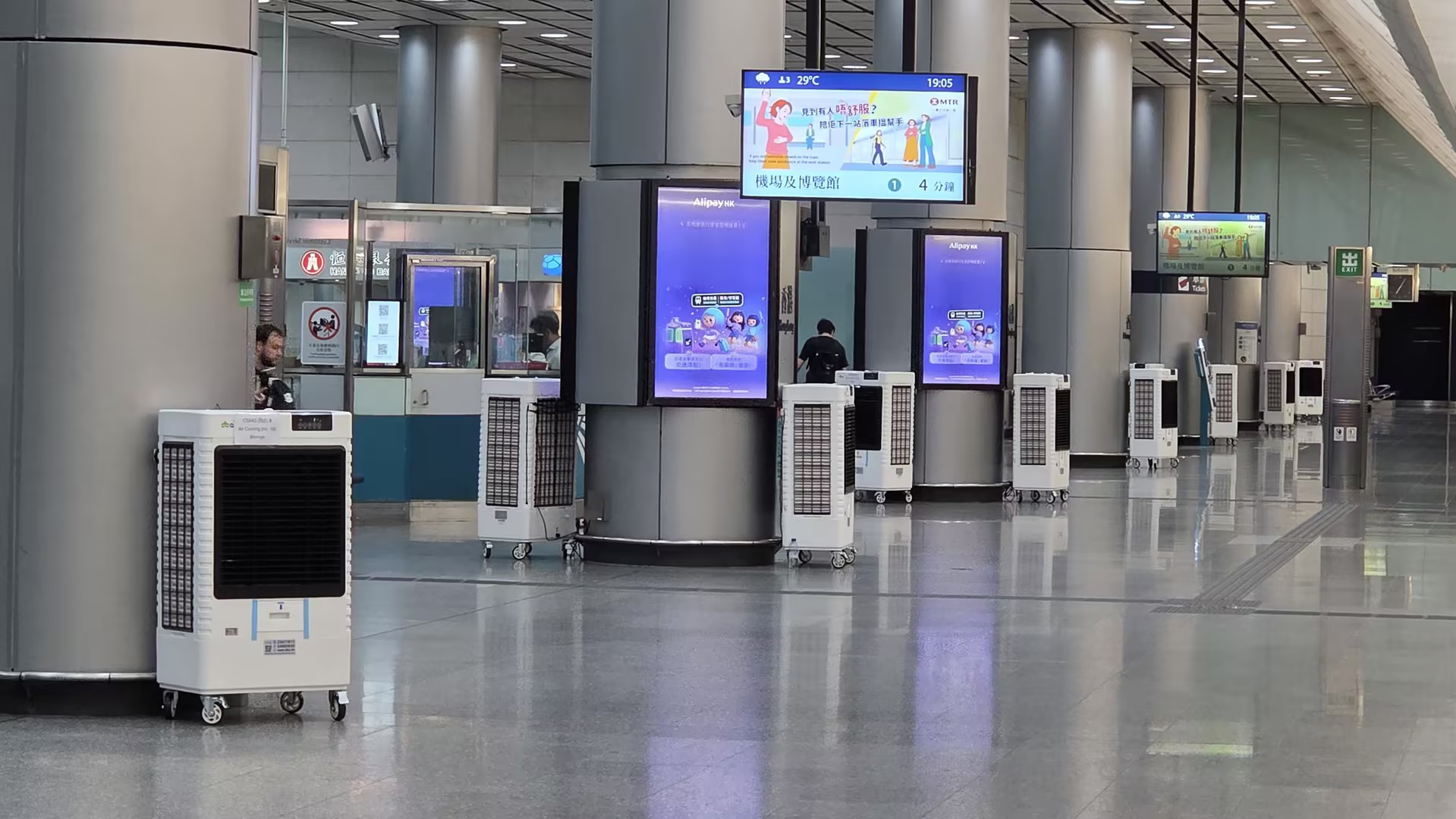
Row of white SEPAT mobile evaporative air coolers deployed along a Hong Kong MTR station concourse at 19:05, with Airport and AsiaWorld-Expo signage overhead.
SEPAT mobile evaporative air coolers in service along a Hong Kong MTR station concourse. Photo: SEPAT
SEPAT's mobile evaporative air coolers are now in service inside a Hong Kong MTR station, adding a mobile layer of cooling to one of the busiest public transport environments in Asia.
The deployment puts the equipment where building air conditioning alone rarely reaches: the open, constantly re-opened concourse where passengers queue, walk and wait. Hong Kong's summers are getting hotter, station footfall is heavy, and the concourse behaves more like a street than a room.
Why a Hong Kong station concourse is a hard cooling problem
On 9 August 2026, the Hong Kong Observatory recorded 36.9 °C at its Tsim Sha Tsui headquarters — the highest since records began in 1884 — while other parts of the city passed 38 °C.[1] The Observatory had already forecast that 2026 would rank among the ten hottest years in the city's history.[2]
The passenger load is just as demanding. In July 2026, MTR's Domestic Service carried an average of 4.53 million passengers on a weekday, with 286,000 cross-boundary trips and 34,600 Airport Express trips per day.[3] A concourse, however, is not a sealed room: entrances, escalators and ticket halls stay open to the street, trains displace the air every few minutes, and every passenger adds heat. Central air conditioning is designed for a steady-state load, so the problem is rarely the average air temperature — it is where the heat collects, and when.
What SEPAT deployed
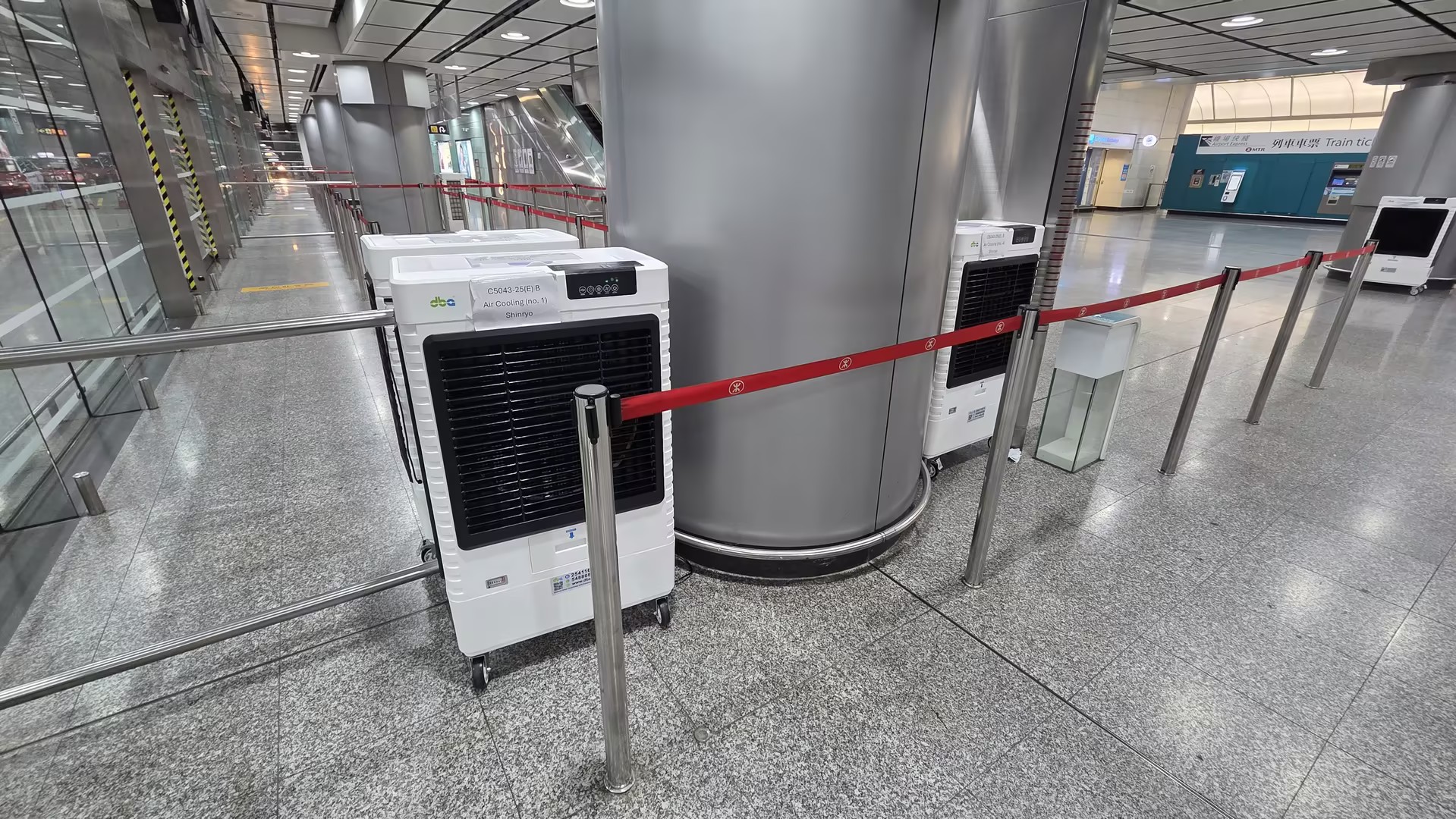
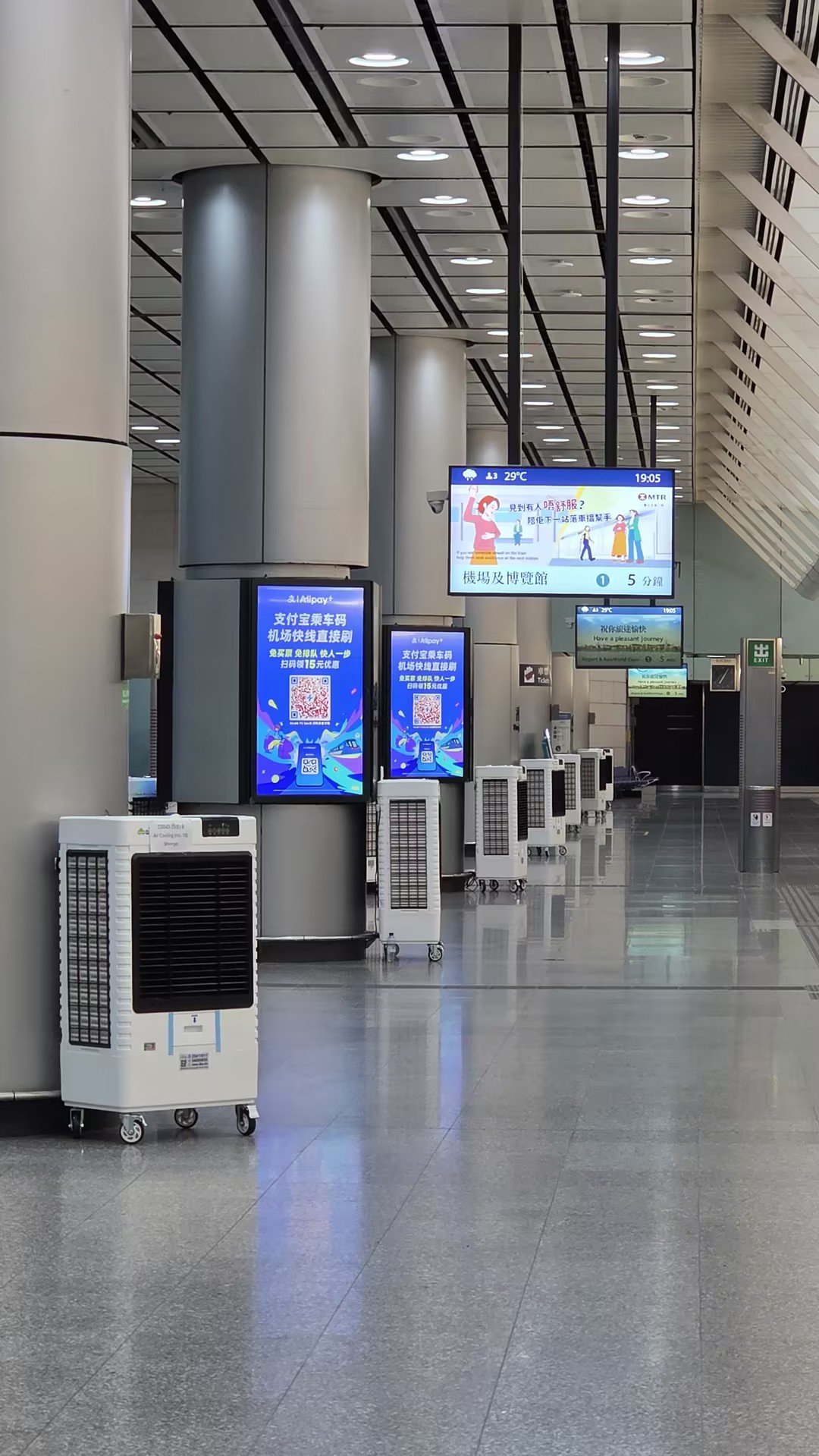
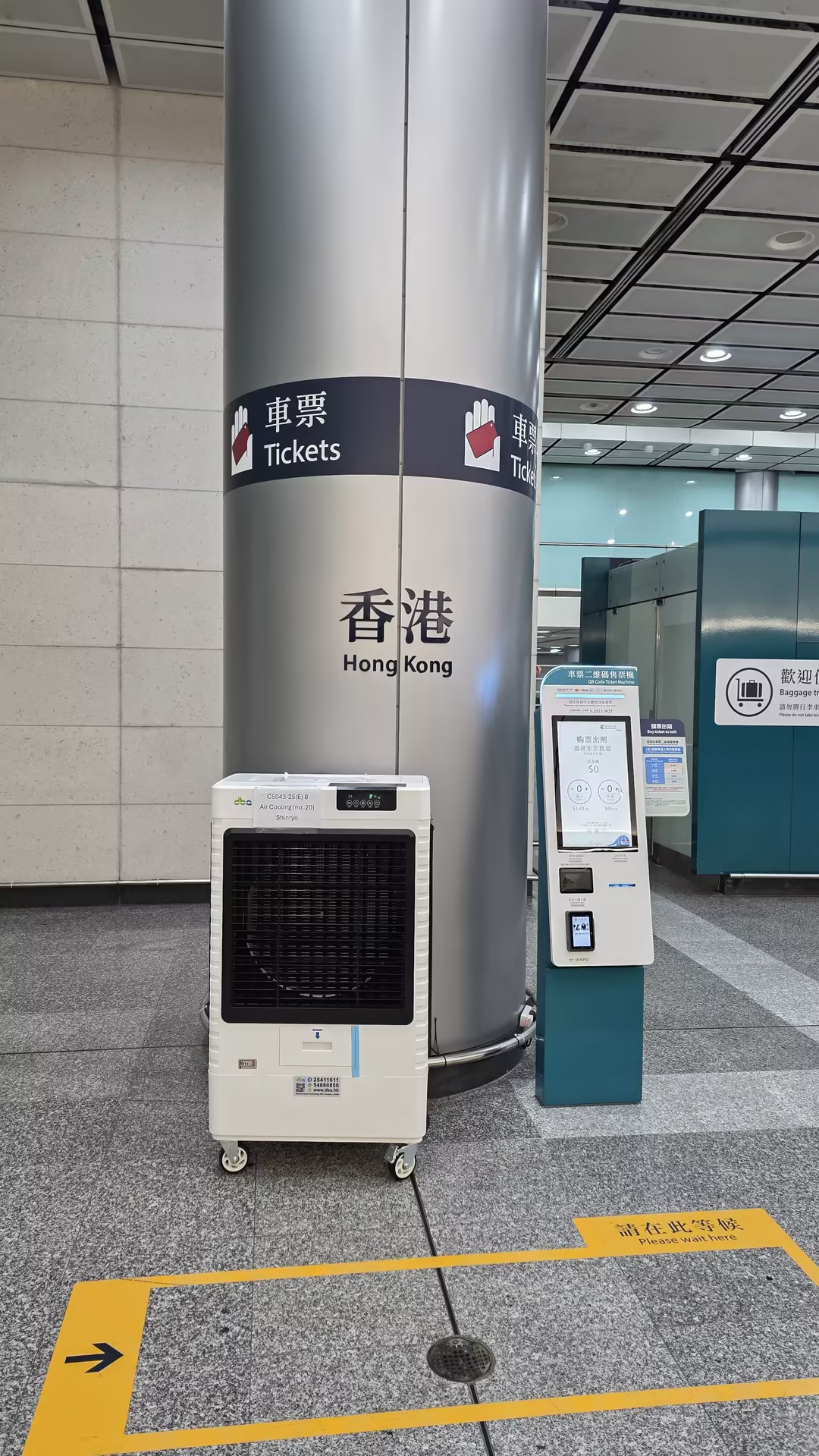
The photograph above was taken at 19:05, when the station's information display read 29 °C. Multiple SEPAT coolers stand in a line along the concourse between the structural columns, beside the passenger walking route and the wayfinding signage for the Airport and AsiaWorld-Expo. Every unit sits on castor wheels and runs from a standard power socket, so cooling capacity can be repositioned within minutes.
Mechanically, the units work on the evaporative (adiabatic) principle: a fan draws air through a water-saturated honeycomb cooling pad, the water evaporates, and the air leaves several degrees cooler. There is no compressor, no refrigerant circuit and no ducting to install, and each unit runs unattended for a full shift between refills from its own water tank.
Why evaporative cooling suits a metro concourse
Evaporative cooling is not a replacement for a station's central air conditioning — it is a different tool for a different job, and in an open concourse that difference is the point.
It cools people, not the whole building. Units sit on the passenger route, so cooling lands where heat is felt.
It moves with the crowd. Castor-mounted equipment can be redeployed between concourse zones and gate lines with no building work.
It draws very little power. With no compressor, a standard socket is enough — useful where the chiller plant cannot take more load.
It uses water, not refrigerant. Water as the cooling medium supports the energy and emissions targets transport operators publish each year.[4]
It installs without interrupting service. No ductwork, no pipework, no night works, no platform closure.
What the deployment delivers for the operator
The visible outcome is a cooler band of air along the concourse walking route during the hottest hours, when comfort complaints and heat-stress risk peak. Because the equipment is mobile, that cooling follows the problem — concentrated at a gate line in the morning peak, moved to a waiting area in the evening. Three operational questions are answered up front:
Seasonality. Units run in the hot months and are stored for the rest of the year, so cooling cost tracks the weather instead of sitting in the building's fixed load.
Scalability. Capacity grows by adding units, not by modifying building services.
Maintenance. Servicing is limited to the water tank, cooling pad, pump and motor — within reach of the station's existing maintenance team.
Measured performance data for this installation is being collected at station level and will be published on request to qualified operators and consultants. [Add site measurements here once confirmed — air temperature difference at the passenger route, unit runtime, water consumption per shift.]
The same approach works beyond rail
The same conditions — large open volume, constant door traffic, dense occupancy, a fixed central plant — apply to ferry terminals, bus interchanges, warehouses, factory floors, exhibition halls and commercial kitchens, where SEPAT mobile evaporative coolers are already in use.
About SEPAT
SEPAT is the brand of Taizhou Weiye Refrigeration Equipment Co., Ltd., a cooling equipment manufacturer established in 2007. The company runs a production facility of more than 10,000 m² with a daily output of 1,500–2,000 units, and manufactures portable, floor-standing and heavy-duty evaporative air coolers, industrial fans and heaters. Equipment is CCC, CE, FCC, CB, ROHS and ISO 9001 certified, covered by a one-year warranty and a 1 % free-of-charge spare parts policy, and available for OEM and ODM projects with customer-branded control panels and packaging.
Frequently asked questions
Are evaporative coolers effective inside a public transport station?
Yes, when they are used for supplementary or spot cooling rather than as a replacement for the station's central air conditioning. Because the units are mobile, they can be positioned directly on the passenger route, in gate lines and in waiting areas, where fixed cooling often does not reach.
Do the units need ducting, drainage or building work?
No. The coolers are self-contained and castor-mounted, run from a standard power socket and carry their own water tank. No ductwork, no refrigerant pipework and no structural modification are required, so they can be brought into service without interrupting operations.
Can SEPAT supply these units in volume, and can they be branded?
Yes. SEPAT manufactures the mobile evaporative cooler range at its own facility and supplies OEM and ODM projects with customer branding, specified voltage and plug standards, and custom packaging. Standard minimum order quantity is one 40-foot high-cube container.
Talk to our export team
For full specifications, container pricing, or help scoping a supplementary cooling project, contact the SEPAT export team — or meet us at the 140th Canton Fair (Booth 2.1Y37-38, October 15-19, 2026), Global Sources Smart Home, Security and Appliances(Booth 7T24, October 18-21, 2026) and the 32nd China Yiwu International Commodities Fair (Booth D1-F55/56-G17/18, October 21-24, 2026).
Sources
[1] Hong Kong Free Press, "Hong Kong sees hottest day on record as Observatory HQ records 36.9°C", 9 August 2026 — hongkongfp.com
[2] Time Out Hong Kong, "Hong Kong Observatory predicts 2026 to be one of the hottest years on record", 31 March 2026 — timeout.com
[3] MTR Corporation, Patronage Updates (July 2026 figures) — mtr.com.hk
[4] MTR Corporation, Greenhouse Gas Emissions Reduction — mtr.com.hk
Photograph taken in a Hong Kong MTR station. "MTR" is referenced descriptively to identify the operating environment; SEPAT is an independent equipment manufacturer and this article does not imply endorsement by MTR Corporation Limited.
 |
 |